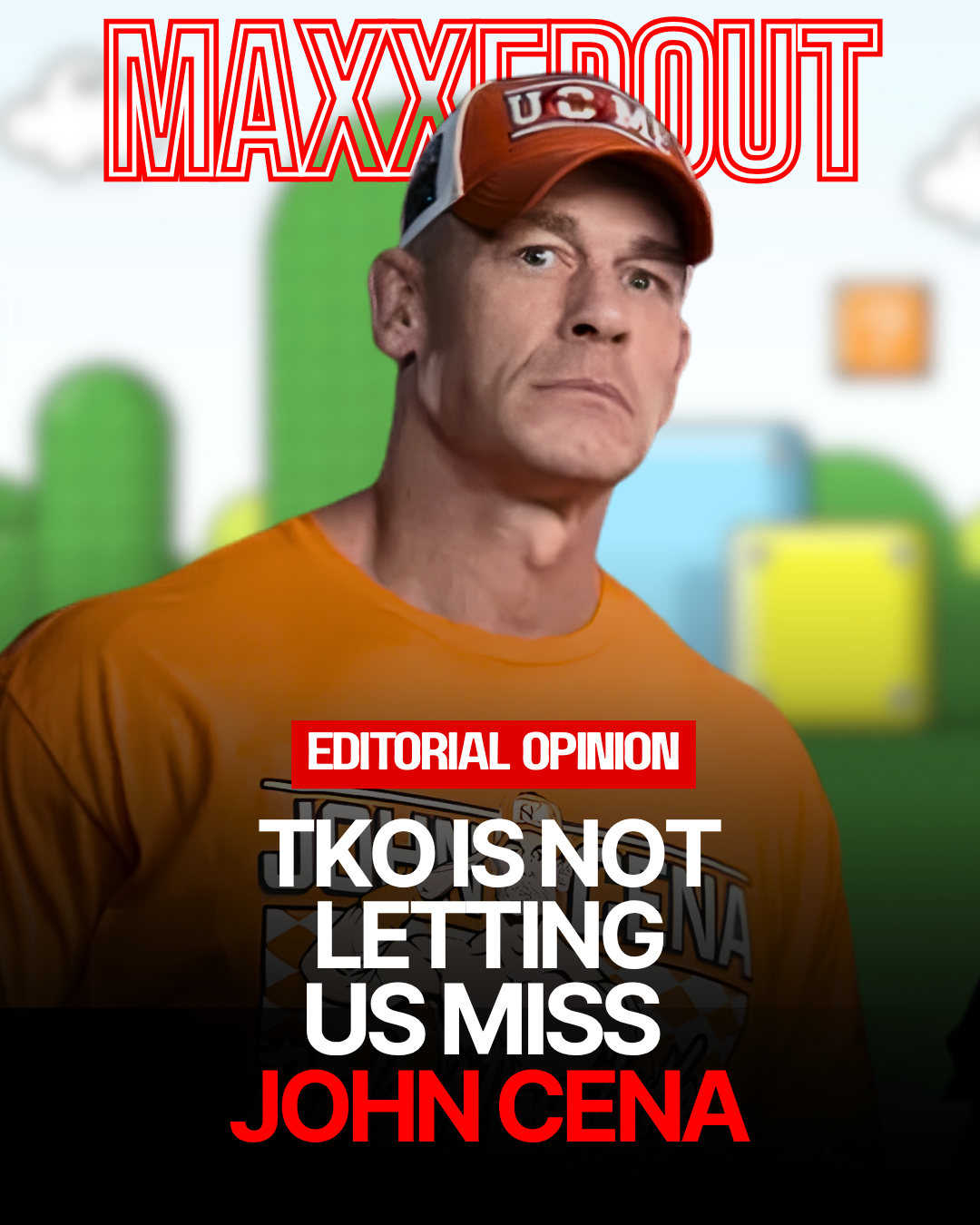
A lot of fans are sitting with the same quiet frustration right now: we didn't get to miss him.
Not in the small way. In the real way.
John Cena's last run wasn't packaged like another part-timer cycling through. It was framed as an ending. The dates were finite. The tone was different. WWE asked the audience to treat it as something closer to a final chapter than a break, and the audience showed up for that ask. People traveled. People cried. People paid attention to matches they would've shrugged at a year earlier, because the frame told them this one counted.
Then the frame disappeared.
The return came so fast that the ending it was supposed to follow never had room to settle. And once you do that, you're not extending the story. You're rewriting the moment that was supposed to matter.
That's the fumble.
This isn't about whether Cena belongs on TV. His value isn't the question and never was. The question is what happens when you sell something as a closing chapter and then immediately treat it like it wasn't one. Because the second that happens, every future moment loses a little weight. The audience starts pricing in the discount before WWE even books the next one.
WWE is clearly trying to position him as a special attraction now. Limited dates. Big shows. Controlled exposure. On paper, that's exactly the playbook for protecting a star at his level.
But special attraction status isn't built by the schedule. It's built by absence.
You don't earn rare by appearing less. You earn rare by being gone long enough that the audience starts to feel the shape of where you used to be. That's the part of the equation WWE skipped. The retirement tour was the rare thing. The silence that should've followed was supposed to be the other half of it. Both got compressed into the same content cycle, and now neither one carries what it was built to carry.
That gap matters more than people realize. Absence isn't dead air. It's the mechanism that turns a return into an event. It lets chants fade just enough that hearing them again feels like something. It lets highlight clips start to feel like memory instead of last month's programming. Without that distance, a return is just another booking. The pop is reflex, not catharsis.
This isn't only a Cena issue, either. It plugs into a bigger pattern under the current creative direction: a heavy lean on reliability. Recognizable names. Established stars. Reactions that are guaranteed before the entrance music hits. From a business angle, that logic is airtight. Established equity is the safest bet on the board.
Creatively, the bill comes due somewhere else.
Because not every moment is supposed to be maximized. Some are supposed to be left alone on purpose. The Cena exit was one of those. Letting it breathe would've protected its value and protected the value of the return that eventually followed it. Activating it immediately did the opposite. It flattened both ends of the curve at the same time.
So we're sitting in the middle of it now. The goodbye didn't fully land. The return doesn't fully hit. It just exists, occupying space the moment was supposed to occupy on its own.
The reactions will still come. The respect is permanent. But the weight is the part you can't fake, and the weight is what gets thinner every time he shows up before the audience has had a chance to feel his absence.
The harder question underneath all of it isn't whether Cena should be showing up. It's whether WWE understood what they had in that final moment, and why a moment like that needed room around it.
Right now, it doesn't look like they did.
Which is why this feels less like a comeback and more like something that came back before it was supposed to.
If that disconnect is sitting with you too, that's the conversation we're already having every week. Looking past the moment and asking what it actually means.
That's what we do over at MaxxedOut: https://maxxedout.se/podcast
Subscribe, follow on TikTok, and jump into the comments. Because this one isn't really about Cena. It's about whether WWE still knows the difference between a moment that should be used and a moment that should be left alone.